
For a European brand, entering the US market means treating American customers as a primary market rather than an occasional source of international orders. Many brands cross that line by accident, through a few cross-border sales, long before they cross it on purpose with a real plan. This guide is for the brands ready to do it on purpose: DTC and Shopify companies in the $3M–$10M range, and European SMEs with traction at home that now want share in the largest single consumer market in the world.
The US is one market of over 330 million people, one language, one currency, and one set of federal rules. That is the opportunity. It is also why it punishes brands that arrive treating it like a bigger version of their home country. In the entries we have run, brands that focused on a single beachhead segment reached positive contribution margin after acquisition (CM3) in the US by month four or five, instead of burning budget chasing traction.
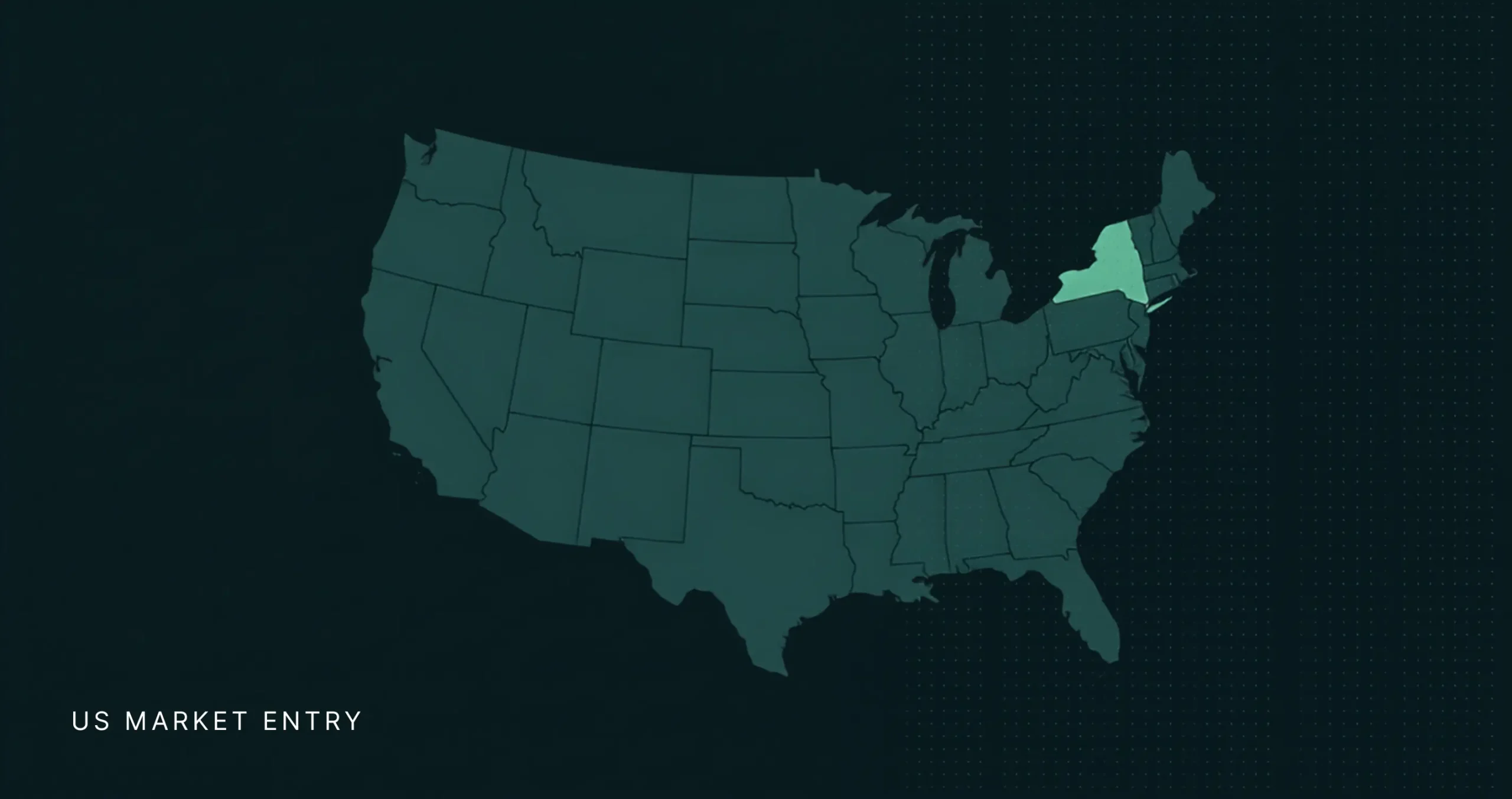
What does entering the US market actually mean for a European brand?
There is a difference between shipping to the US and selling in the US. Shipping is fulfilling orders that happen to come from American addresses. Selling is building demand on purpose: positioning for an American buyer, pricing against American competitors, and running the operations an American customer expects.
That distinction decides almost everything that follows. A brand that “ships to the US” can run on its home setup and a translated checkout. A brand that “sells in the US” needs a position, a channel, US-side logistics, and a tax footprint. Confusing the two is the most expensive mistake we see, because it hides the real cost until the orders arrive.
So the first decision comes before choosing an agency or an ad platform. It is honesty about which of these two you are actually doing, and whether you have the margin and the appetite for the second one.
Why is the US harder than European brands expect?
European founders tend to picture the US as easier than Europe because it removes the friction they know best: no language barrier across states, no currency conversion, no patchwork of national regulations for basic commerce. All true. The friction just moves somewhere they are not looking.
Acquisition is the first surprise. You are bidding for attention against companies with US-sized budgets in the most competitive ad auctions on earth. Customer acquisition cost in your category is likely higher than at home, and your home creative rarely converts the same way. Many brands model their US launch on home-market CAC and run out of runway in the first quarter.
Operations is the second. American shoppers expect fast shipping, often free, and returns that are close to frictionless. The Amazon Prime standard sets the baseline whether you sell on Amazon or not. An EU fulfillment center shipping across the Atlantic cannot meet that expectation on cost or speed.
Tax is the third, and the quietest. The US has no VAT. Sales tax is set by states and localities, and after the 2018 South Dakota v. Wayfair ruling, states can require out-of-state sellers to collect it once they pass an economic threshold. Those thresholds vary by state. Ignore this and the saving is an illusion: you are accruing a back-tax problem that surfaces during diligence or at scale.
How is US go-to-market different from the EU?
The clearest way to see the gap is side by side. Treat the table below as a checklist of decisions, not a summary. Each row is a place where copying your home setup quietly costs you.
| Dimension | EU (your home base) | US |
|---|---|---|
| Market shape | Fragmented by language, currency and national rules | One language, one currency, but regional buying differences and intense competition |
| Pricing display | Prices shown including VAT | Prices shown excluding tax, added at checkout. This changes perceived price and conversion |
| Tax | One VAT registration covers a country; OSS simplifies cross-border | Sales tax by state and locality, collection triggered by economic nexus |
| Payment | Diverse and local: SEPA, iDEAL, Bancontact, Multibanco/MB WAY, Klarna | Card-dominant, with buy-now-pay-later growing fast. Local EU methods are irrelevant |
| Shipping and returns | Varies by country; expectations moderate | Fast or free shipping is the baseline; liberal returns are expected |
| Customer service | Often email-first, business hours by country | Expect responsive support across US time zones, phone or chat included |
| Trust signals | Local domain, local reviews | .com domain, US reviews, US address and number, US spelling and sizing |
None of these rows is hard on its own. The damage comes from treating them as cosmetic and shipping a checkout that feels foreign to an American buyer at the exact moment they decide whether to trust you.
What does a US market entry strategy look like, step by step?
Here is the framework we run, in the order we run it. It is built to spend the least amount of money before you have evidence, then move fast once you do.
1. Validate demand before you spend
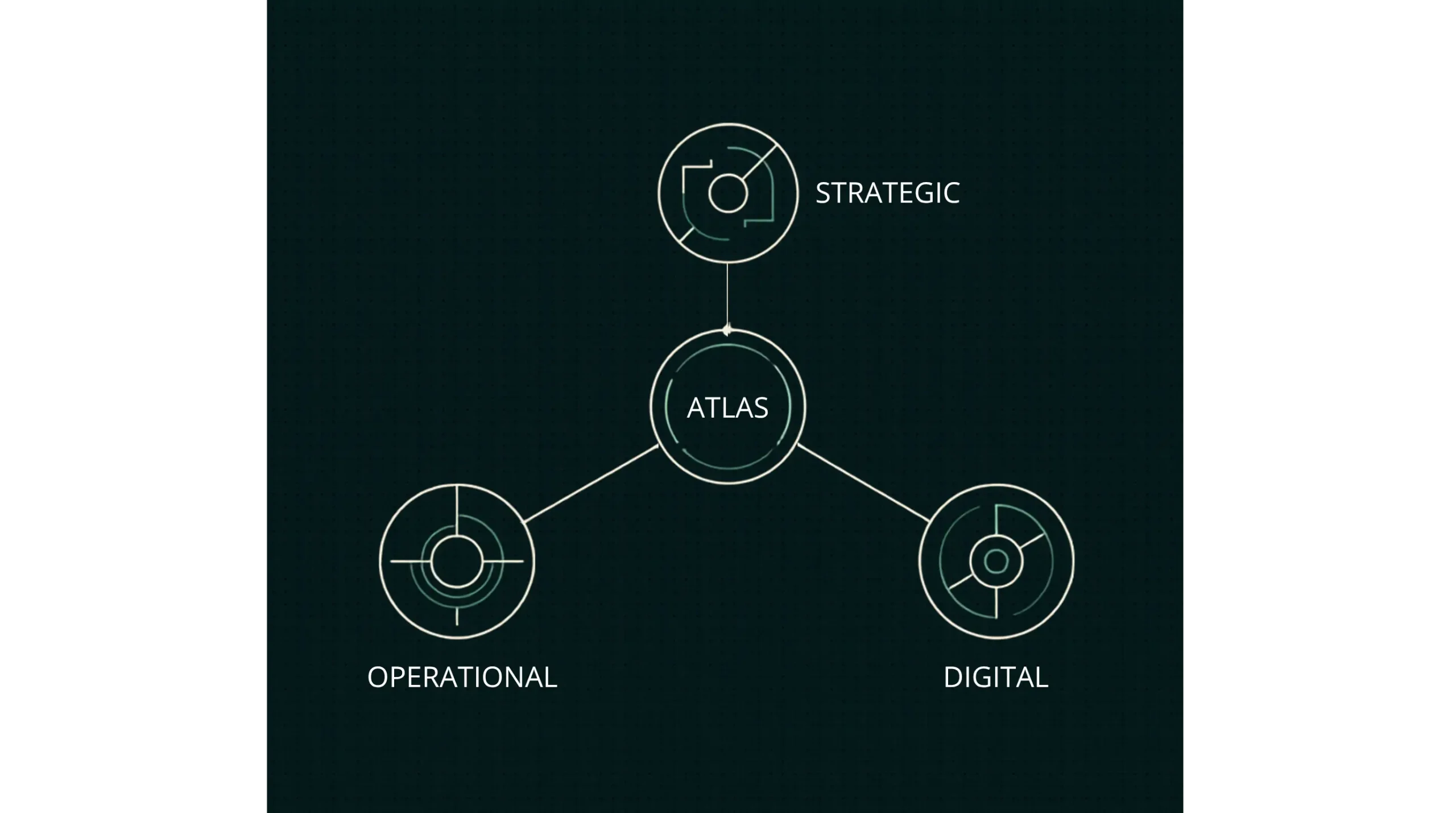
Before logistics, before an entity, before media budget: confirm there is a specific US segment that wants what you sell, and that you can reach it profitably. That means search and category demand, the price the market already pays, and which competitors own the consideration set. The output of this step is a go or no-go on a single beachhead segment, not a vague “the US is big.” This is the discipline we run as the 360° Analysis, the first phase of the Klevie Growth Engine: a diagnosis powered by our Atlas Diagnostic System, which combines AI with our framework to surface patterns and growth blockers across the strategic, operational and digital dimensions of the business, with every conclusion validated by senior consultants.
2. Position and localize, which goes beyond translating
Localization is rebuilding the experience for an American buyer, not swapping British spelling for American. It covers sizing, units, date formats, the tone of your copy, the proof you show, and the objections you answer. A brand that translates wins nothing. A brand that localizes feels like it was built for the customer in front of it. We go deeper on this in how to localize your brand for US customers.
3. Choose a go-to-market model and channel
Owned DTC store, marketplace, retail, or a mix. Each has a different cost of entry and a different speed. Most DTC brands start with their own US storefront plus paid acquisition into the beachhead segment, then layer marketplace or retail once the unit economics hold. The model is a decision, not a default, and it should follow the validation in step one.
4. Set up operations, logistics and compliance
US-side fulfillment so you can meet shipping expectations, a payment stack built for cards and BNPL, a returns process an American shopper recognizes, and a tax setup that registers and collects where you have nexus. This is also where you decide on a US entity and the practical pieces around it. This is not legal or tax advice; structure and registration should be confirmed with a US accountant and counsel before you act.
5. Run the first 90 days as a sprint
Launch into the beachhead, not the whole country. The first month is diagnosis, setup and preparation; activation in market comes next, and with it the first real read on the metrics that matter: acquisition cost, conversion, first repeat purchase, and contribution margin after shipping and returns. Review weekly, cut what does not work, and expand only from evidence. The point of the sprint is to be wrong cheaply and fast, then double down on what holds. That is why we run weekly check-ins and document every test, from audiences to creative, copy and landing pages, with a record of what worked and what did not.
How should DTC and Shopify brands approach US expansion?
If you already run on Shopify, you have a shorter path than most, but a few specific moves matter.
Use a US-facing storefront experience with US pricing shown the way Americans expect, card-first payments, and BNPL enabled. Move fulfillment to a US 3PL, or split inventory, so delivery times match the baseline rather than fighting it. Get sales tax collection configured for the states where you have nexus before volume builds, not after. And localize the parts that drive trust at checkout: reviews from US customers, a US support option, sizing and units in American terms.
The mistake we see most with Shopify brands is assuming the platform handles the strategy because it handles the plumbing. It handles the plumbing. The position, the price, the beachhead and the margin model are still yours to get right. We lay out the full sequence in Shopify DTC expansion to the US.
What are the most common mistakes European brands make?
These are the patterns that come up again and again. Each one starts as a reasonable shortcut and ends as a cost.
- Treating the US as one homogeneous market. Ironically, the brands most careful about country differences inside Europe assume the US is uniform. It is one market, but a brand for Brooklyn is not the same as a brand for Dallas. Pick a beachhead.
- Modeling on home-market CAC. Underpricing the cost of attention is what empties the runway in the first quarter. Model US acquisition cost, then check the margin survives it.
- Running EU shipping and returns. Slow delivery and an awkward returns flow lose the second purchase, which is where DTC economics actually live.
- Ignoring sales tax until it is a problem. Nexus does not wait for you to notice it. Register and collect on time, or carry a liability that surfaces at the worst moment.
- Translating instead of localizing. A literal translation reads as foreign and quietly suppresses trust at the exact point of conversion.
- Launching everywhere at once. Broad launches spread budget thin and produce no clear signal. A focused entry produces evidence you can act on.
We go through each of these with examples in common mistakes when expanding to the US market.
How long does it take and what does it cost?
The honest answer is that it depends on the model you choose and the margin you have to fund acquisition. A DTC brand validating a single beachhead can have real signal within a quarter. Building durable share takes longer, usually a few quarters of disciplined iteration on position, price and channel.
Cost splits into three buckets: setup (US operations, payments, tax, entity), acquisition (the budget to buy attention and learn), and the cost of being wrong (the returns, the failed creative, the channel that did not work). The third bucket is the one brands forget to budget, and it is the one the sprint model is designed to keep small.
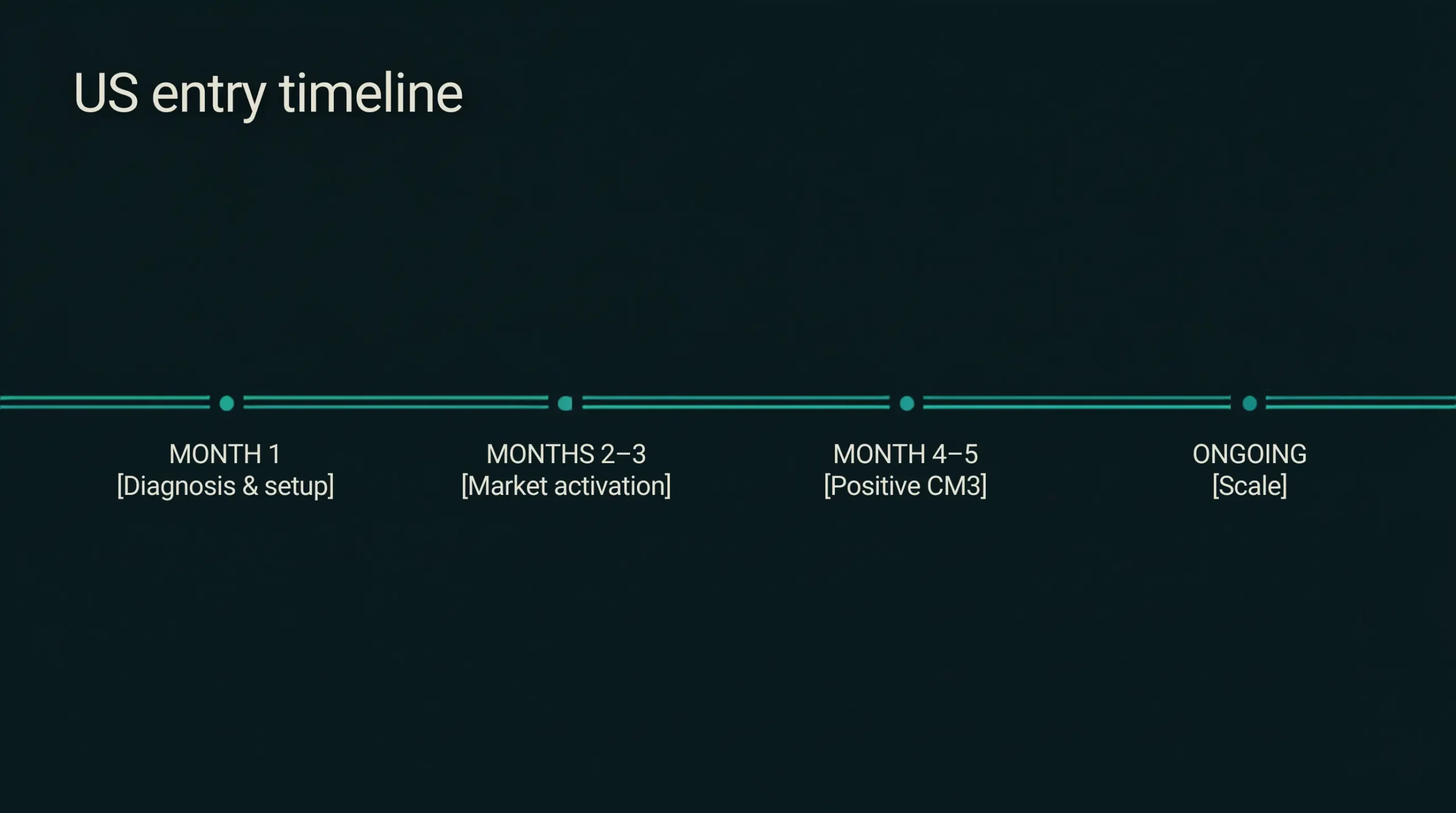
In practice the model is variable: a monthly fee that mostly covers our operating costs, plus a success fee tied to KPIs we set together with the client in month one, when we run the Klevie Growth Engine diagnostic. Setup of operations, payments and go-to-market is included; the tax side sits outside this and should be handled with a US accountant. The pace depends on the product, but on average it runs like this: month one for diagnosis, setup and preparation, months two and three for activation in market, and positive contribution margin after acquisition by month four or five. The investment starts paying back while you are still learning the market, not years later.
Whatever the numbers, the principle holds: spend the minimum to get evidence, then spend behind what works. Brands that do the opposite, spending big to “make a splash,” usually learn the same lessons later and more expensively.
Frequently asked questions
Do European brands need a US legal entity to sell in the United States?
Not always to start, but many brands set one up as they scale to simplify payments, banking, tax registration and trust. The right structure depends on your model and should be confirmed with a US accountant and counsel.
How does US sales tax work compared to European VAT?
There is no federal VAT in the US. Sales tax is set by states and localities, and you are generally required to collect it once your sales in a state pass that state’s economic nexus threshold. Thresholds and rules vary by state.
What is the biggest difference between EU and US go-to-market?
The US is a single large market with one language and currency but extreme competition and high acquisition costs. Success depends less on reach and more on a sharp position, US-grade operations, and margin that survives US acquisition cost.
Should I launch across the whole US at once?
No. A focused beachhead segment gives you a clear signal on whether your position, price and channel work. Broad launches spread budget thin and make it hard to learn anything actionable.
Is translating my website enough to sell in the US?
No. Translation handles language; localization rebuilds the experience for an American buyer, covering pricing display, sizing, units, proof, support and tone. Localization is what protects conversion.
How long before a US entry starts paying off?
A focused DTC entry can produce real signal within a quarter. Durable share usually takes several quarters of disciplined iteration. The timeline depends on your model and your margin to fund acquisition.
Planning your US entry?
We run US market entry as an execution sprint, not a slide deck: validation, positioning, operations and a focused 90-day launch. Request a strategy call and we will tell you, honestly, whether the US is worth it for your brand right now.
Want the checklist first? Grab the US Market Entry Checklist for European SMEs.