
Expanding a Shopify store to the US is not a setting you switch on. Shopify gives you the plumbing for international selling, but the strategy, a focused entry, US-grade operations, and margin that survives US acquisition cost, is still yours to get right. This roadmap walks through both: the Shopify setup and the decisions around it. It is a companion to our full guide to US market entry for European brands.
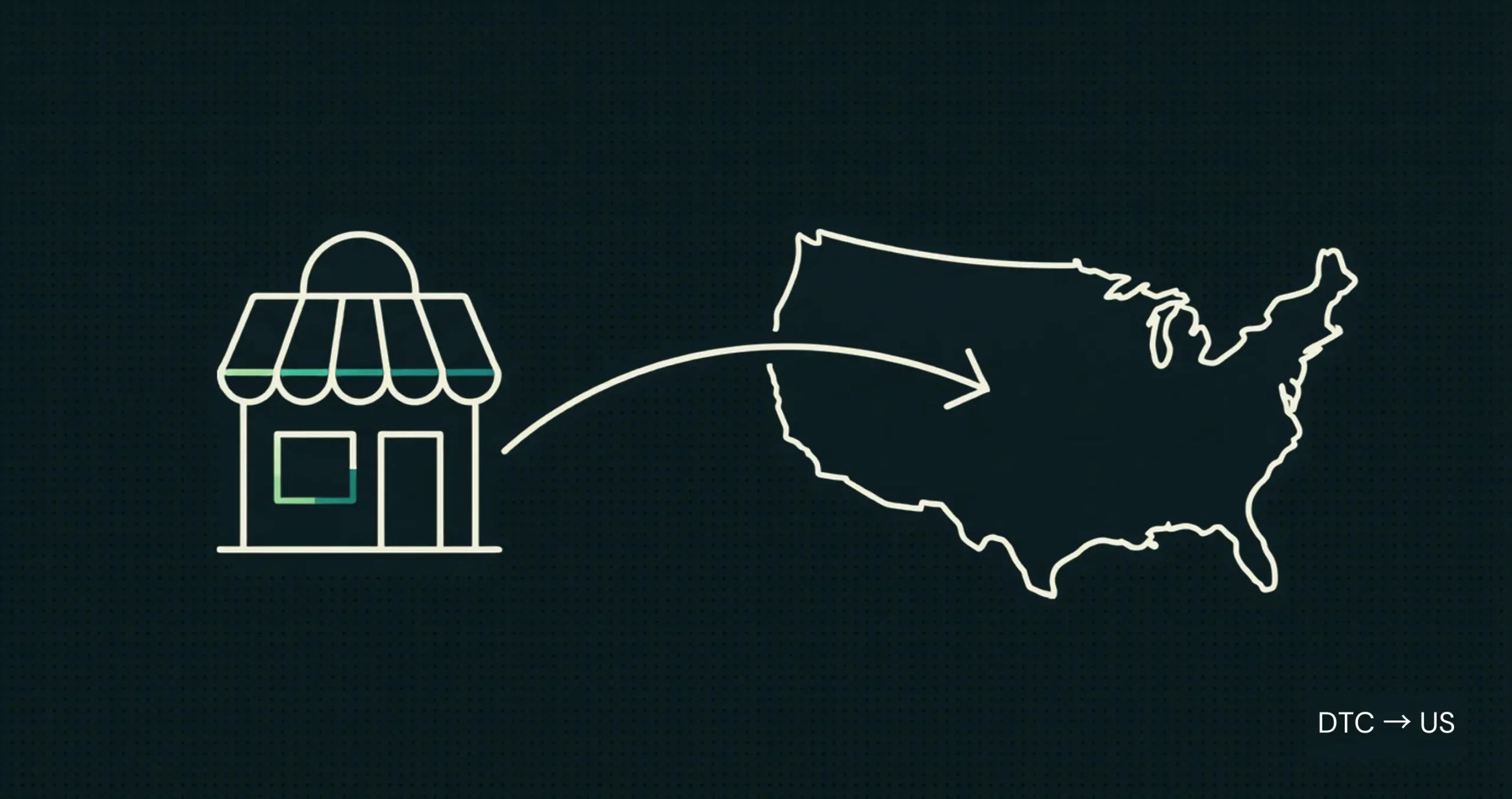
Is expanding a Shopify store to the US just flipping a setting?
No, and assuming it is the most common reason Shopify brands stall. Shopify makes the technical side genuinely easy: you can sell into the US with US pricing, US currency and US payments without rebuilding your store. What it does not do is decide who to sell to, how to position, what to charge, or whether your margin survives US acquisition cost. The platform handles the plumbing. The strategy is still a decision.
The brands that do well treat the Shopify setup as the easy 20% and the strategy as the 80% that decides the outcome. The ones that struggle do the reverse: they configure Shopify Markets in an afternoon, turn on US ads, and wonder why the numbers do not work.
The plumbing Shopify gives you
Shopify’s international tools cover most of the technical work of selling in the US:
- Shopify Markets lets you run the US as a distinct market: its own pricing, currency, domain or subfolder, and market-specific settings, all from one store.
- Multi-currency and US pricing let you show prices in US dollars and set US-specific prices rather than just converting your home price.
- Shopify Payments handles US card payments, and Shop Pay Installments adds the buy-now-pay-later option US shoppers increasingly expect.
- Shopify Tax helps calculate US sales tax and flags where you may have obligations as you grow.
This is real leverage. It means a European Shopify brand can stand up a credible US storefront fast. The mistake is thinking that because the setup is fast, the entry is done.
What Shopify does not solve for you
Four things sit outside the platform, and they are the four that decide whether the US works: which beachhead segment to target, how to position and price against US competitors, US-grade fulfillment and returns, and whether your contribution margin after acquisition can carry the spend it takes to grow. None of these has a toggle. They are the work.
The roadmap, step by step
1. Validate US demand and pick a beachhead
Before configuring anything, confirm there is a specific US segment that wants your product and that you can reach it profitably. Pick one beachhead rather than launching at the whole country. This is the diagnosis the rest of the roadmap depends on.
2. Set up the US storefront
Use Shopify Markets to create the US market: US dollar pricing shown the way Americans expect, which is excluding tax with tax added at checkout, on a US domain or subfolder. Price against US competitors, not by converting your home price.
3. Payments and checkout
Enable Shopify Payments for US cards and turn on buy-now-pay-later through Shop Pay Installments. Drop the European local methods that do nothing for a US shopper. The goal is a checkout that shows the payment options a US buyer trusts.
4. Fulfillment, shipping and returns
Move fulfillment to a US 3PL or split inventory so delivery times match the US baseline of fast, often free shipping. Build a returns process an American shopper recognizes. This is where the second purchase is won or lost, and the second purchase is where DTC economics live.
5. Sales tax
Use Shopify Tax to calculate sales tax, and register and collect in the states where you have economic nexus. Thresholds vary by state and the obligation does not wait for you to notice it. This is not legal or tax advice; confirm your specific obligations with a US accountant.
6. Localize the experience
An English-language store can still feel foreign through sizing, units, proof and contact details. Localize the checkout path and trust signals for a US buyer. We cover this in how to localize your brand for US customers.
7. Acquisition and the margin test
This is the step that decides whether you can scale. Model US acquisition cost honestly, then check that contribution margin after acquisition (CM3) stays positive. If it does, spending more to grow makes sense. If it does not, fix the economics before you scale, not after. We break this down in what is contribution margin (CM1, CM2, CM3).
Common mistakes Shopify brands make expanding to the US
The pattern is almost always the same: treating the fast Shopify setup as the whole job. Brands turn on US ads before validating a segment, convert prices instead of benchmarking them against US competitors, ship from Europe and miss the speed baseline, ignore sales tax until it is a liability, and model on home-market acquisition cost. Each one is avoidable, and we list them alongside the rest in common mistakes when expanding to the US market.
Frequently asked questions
Can I sell to the US on Shopify without a separate store?
Yes. Shopify Markets lets you run the US as a distinct market from your existing store, with its own pricing, currency, domain or subfolder, so you do not need to rebuild.
What does Shopify handle and what do I still need to do?
Shopify handles the technical side: US pricing, currency, payments and tax calculation. You still have to choose a beachhead segment, position and price against US competitors, set up US fulfillment, and make sure your margin survives US acquisition cost.
How should I handle payments for US Shopify customers?
Enable Shopify Payments for US cards and add buy-now-pay-later through Shop Pay Installments. European local methods are irrelevant to US shoppers.
Do I need to deal with US sales tax on Shopify?
Yes. Use Shopify Tax to calculate it and register and collect where you have economic nexus. Thresholds vary by state. Confirm your specific case with a US accountant.
What is the most important number when expanding a Shopify brand to the US?
Contribution margin after acquisition (CM3). It tells you whether each new US customer still contributes after the cost of acquiring them, which is what decides whether you can scale profitably.
Expanding your Shopify brand to the US?
We run US entry as a diagnosis first, then a focused launch built on your numbers. Request a strategy call and we will look at whether your margin can carry US growth before you spend to find out.