
A growth strategy is the plan for how a company will grow on purpose: which customers to win, how to reach them profitably, and which constraint to fix first. It is broader than marketing and more focused than a business plan. Done well, it starts with a diagnosis of what is actually holding growth back, then puts the right work in the right order. This guide covers what a growth strategy is, how to diagnose the real bottleneck, the components that matter, and how to build one step by step.
What is a growth strategy?
A growth strategy is a set of decisions about where growth will come from and how you will get it. It answers a few concrete questions: who is the customer worth winning, what will make them choose you, how will you reach them at a cost that leaves margin, and what has to be true operationally for that to scale. Everything else is tactics.
A growth strategy and a list of activities are different things. Running ads, posting content, hiring a salesperson: those are tactics, and tactics without a strategy tend to cancel each other out. A strategy is the logic that decides which tactics belong together and in what order, because it starts from the constraint that is actually limiting growth.
How is a growth strategy different from marketing?
Marketing is one lever inside a growth strategy. A growth strategy also covers pricing, the business model, the sales process, retention, and the operations that carry all of it. Treating growth as a marketing problem is the most common and most expensive mistake, because it sends money at the symptom when the constraint often sits somewhere else: the price is wrong, the product does not retain, or the team cannot deliver at the volume the marketing would create.
How is it different from a business plan?
A business plan describes the whole company, often for investors, and tends to sit still once written. A growth strategy is narrower and more active. It focuses on the specific constraint limiting growth right now, sets a plan to remove it, and gets revisited as the constraint moves. A business plan is a document. A growth strategy is a working decision that changes as you learn.
Why does growth stall?
Growth usually stalls for a reason the company has misdiagnosed. The founder assumes it is lead volume and hires an agency, when the real problem was that the product loses customers after the first purchase, or the pricing gives away the margin needed to acquire anyone profitably. Money goes to the loudest assumption instead of the actual constraint. Working through why your company isn’t growing is how you avoid that, and it is why the choice between growth consulting and a marketing agency matters more than it looks.
This is why a serious growth strategy begins with diagnosis, not activity. Before you spend, you want to know which of a handful of things is the binding constraint: demand, positioning, pricing, the acquisition channel, conversion, retention, or the operation behind delivery. Fixing the wrong one is expensive and slow, and it teaches you nothing. This is the thinking behind the Klevie Growth Engine, which runs a structured diagnosis first and only then commits to a plan.
What are the components of a growth strategy?
A complete growth strategy covers six components. Weakness in any one of them caps the others, which is why the diagnosis matters: you are looking for the one that is currently holding everything back.
Positioning and the ideal customer
Positioning decides who you are for and why they should choose you over the alternatives, including doing nothing. A sharp position on a specific customer beats a broad message aimed at everyone. Growth problems that look like a traffic problem are often a positioning problem: the traffic arrives, but the message does not make anyone move. Positioning is the first thing a go-to-market plan has to get right.
Go-to-market (GTM)
The go-to-market model is how you take the offer to the customer: which segments, which channels, which motion (self-serve, sales-led, partner-led), and in what sequence. A good GTM plan is specific about the first beachhead rather than trying to reach everyone at once. It is the difference between a launch that produces a clear signal and one that spreads budget too thin to learn anything. See how to build a go-to-market plan step by step for the full sequence.
Pricing
Pricing is the fastest lever on profit and the one touched least. Price set by copying competitors or by adding a margin to cost usually leaves money on the table or undercuts the funding you need to acquire customers. Pricing is a strategic decision, tied to positioning and to the margin math below, not an afterthought at the end. We go deeper in pricing strategy for scaling companies.
The acquisition model
Acquisition is how new customers arrive and what they cost. The number that matters is customer acquisition cost (CAC) measured against the value a customer brings, not vanity metrics like impressions or clicks. A channel that looks cheap on cost per click can be the most expensive on cost per customer. The acquisition model decides which channels to build and how to measure them honestly.
Retention and lifetime value
Retention is where most durable growth actually lives. Acquiring customers who leave after one purchase is a treadmill: you pay full price for every unit of revenue and never compound. Improving retention raises the value of every customer you already paid to acquire, which in turn lets you afford more acquisition. A growth strategy that ignores retention is usually just an expensive way to stand still.
Unit economics
Unit economics is the math that decides whether growth is profitable or just expensive. The core question is whether each customer still contributes after the cost of serving and acquiring them. The clearest way to see this is contribution margin, layer by layer, down to margin after acquisition. If that number does not hold, scaling spend makes losses bigger, not smaller. We break this down in what is contribution margin (CM1, CM2, CM3).
How do you build a growth strategy, step by step?
The sequence matters as much as the parts. Building a strategy in the wrong order is how companies end up scaling a leaky system.
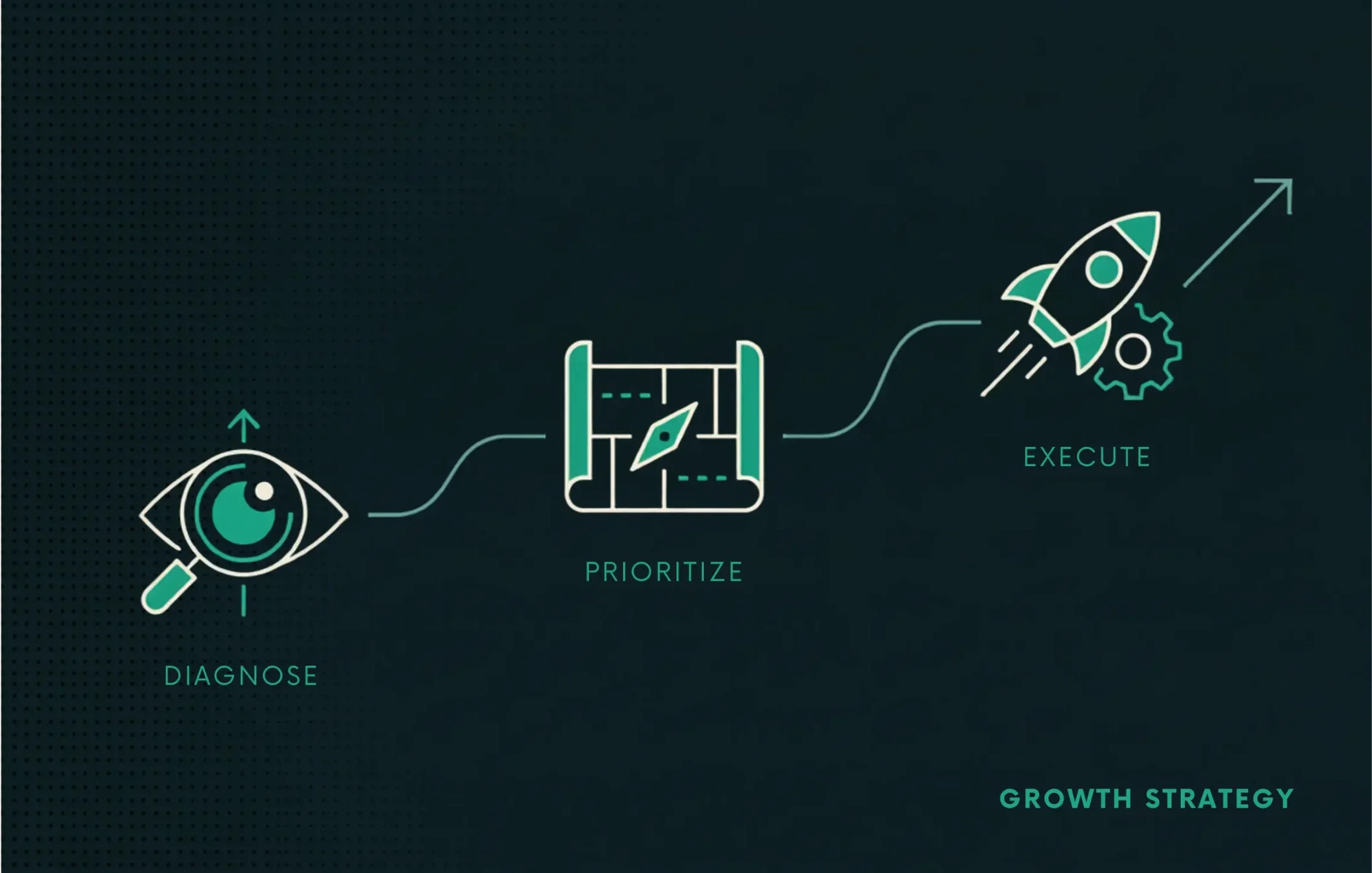
1. Diagnose the constraint
Start by finding the one thing most limiting growth right now. Look across demand, positioning, pricing, acquisition, conversion, retention and operations, and find where the system leaks hardest. This is analysis, not opinion: it should be grounded in the data the business already has. A structured diagnosis is the first phase of the Klevie Growth Engine, delivered through the Scale Check. For a practical walkthrough, see how to diagnose why your company isn’t growing.
2. Prioritize the highest-leverage fix
Once you know the constraint, resist the urge to fix everything. Pick the change that unlocks the most growth for the least effort, and sequence the rest behind it. A short list of high-leverage moves beats a long list of everything that could be improved.
3. Plan the moves and the metrics
For each prioritized move, decide what you will do, what result you expect, and how you will measure it. Attach a metric to every move so you can tell later whether it worked. A plan without metrics is a wish list.
4. Operationalize
Strategy fails at the handoff to execution more often than at the whiteboard. Turn the plan into owners, timelines, and the systems to run it: who does what, by when, tracked how. This is the unglamorous part that decides whether the strategy is real.
5. Iterate on evidence
Run the plan, read the results against the metrics you set, and adjust. Cut what does not work, put more behind what does, and revisit the diagnosis as the constraint moves. Growth is a loop, not a launch: the strategy that wins is the one that keeps learning.
How do you measure a growth strategy?
Measure against the constraint you set out to fix, not against vanity metrics. If the constraint was retention, the headline metric is repeat rate or churn, not impressions. Tie a small set of metrics to the moves in the plan, review them on a regular cadence, and hold the strategy to the outcome it promised. A simple monthly rhythm of “what did we predict, what happened, what changes” beats an elaborate dashboard nobody reads.
Two numbers belong on almost every growth scorecard: customer acquisition cost against customer value, and contribution margin after acquisition. Together they tell you whether growth is compounding or just consuming cash.
What are the most common growth strategy mistakes?
The recurring ones are worth naming so you can avoid them. Treating growth as a marketing problem when the constraint is pricing, retention or operations. Skipping the diagnosis and buying tactics off a shelf. Spreading effort across everything instead of the highest-leverage fix. Scaling spend before the unit economics hold, which makes losses bigger. And measuring activity (posts, impressions, meetings) instead of outcomes (customers, margin, retention). Every one of these traces back to the same root: acting before diagnosing.
When does it make sense to bring in outside help?
Outside help earns its place when you need an honest diagnosis you cannot get from inside, or the execution capacity to act on it quickly. The trap is hiring a specialist for a symptom (an ads agency, say) before anyone has confirmed that the symptom is the constraint. The better sequence is diagnosis first, then the right specialists in the right order. That is how Klevie works: a diagnosis through the Growth Engine, then a focused team on the constraint, from strategy to execution, with one point of contact. If you are weighing a specific market move, our guide to US market entry for European brands shows the same approach applied to one high-stakes decision. And if you are choosing between types of partner, see growth consulting vs marketing agency.
Keep reading: the growth strategy cluster
Each part of this guide goes deeper in its own article:
- How to diagnose why your company isn’t growing, the seven places growth breaks and how to find your constraint.
- How to build a go-to-market plan step by step, from beachhead to launch.
- Pricing strategy for scaling companies, the fastest lever on profit.
- Growth consulting vs marketing agency, and how to tell which one you need.
Frequently asked questions
What is a growth strategy in simple terms?
It is the plan for how a company will grow on purpose: which customers to win, how to reach them profitably, and which constraint to fix first. It is broader than marketing and more focused than a business plan.
What is the difference between a growth strategy and marketing?
Marketing is one lever inside a growth strategy. A growth strategy also covers pricing, the business model, sales, retention and operations. Treating growth as only a marketing problem sends money at the symptom when the real constraint often sits elsewhere.
How do you build a growth strategy?
Diagnose the constraint limiting growth, prioritize the highest-leverage fix, plan the moves with metrics attached, operationalize with owners and timelines, then iterate on evidence. The sequence matters as much as the parts.
What are the components of a growth strategy?
Positioning and the ideal customer, go-to-market, pricing, the acquisition model, retention and lifetime value, and unit economics. Weakness in any one caps the others.
How do you measure whether a growth strategy is working?
Measure against the constraint you set out to fix, not vanity metrics. Two numbers belong on almost every scorecard: customer acquisition cost against customer value, and contribution margin after acquisition.
Not sure what is actually holding your growth back?
That is the question we answer first. Request a strategy call and we will diagnose the real constraint before anyone spends a euro on fixing the wrong one.