
Performance marketing is paid acquisition run against measurable results, where every euro is expected to earn its place. Done well, it grows the profit a business keeps, measured after the cost of acquiring and serving each customer. That means optimizing against margin after acquisition, testing relentlessly, and scaling only what proves it works. This guide covers how Klevie runs performance: the approach to paid media, the testing framework behind it, the role of audiences and tracking, and how it all ties back to profit.
What is performance marketing?
Performance marketing is acquisition you can measure and hold to a number. It covers paid media across search, social and other channels, plus the conversion work on the other side of the click: landing pages, offers, checkout. The defining trait is accountability. Every campaign has a result attached, and spend follows evidence rather than opinion. For ecommerce and DTC brands, it is the engine that turns budget into customers, and the discipline that decides whether those customers arrive at a cost the business can afford.
Where the line sits between performance marketing and paid media
The two terms get used interchangeably, and the difference is worth being precise about. Paid media is the buying: campaigns on search, social, shopping and the rest, judged on what happens inside the ad account. Performance marketing is the wider discipline of acquiring customers against a business result, which includes the buying, the conversion experience it lands on, the measurement underneath it, and the margin math that decides whether any of it was worth doing.
Some define performance marketing so broadly that it swallows every digital activity a company runs, which drains the word of meaning. At Klevie the boundary is drawn where the accountability sits. Performance owns paid acquisition, conversion and the acquisition side of organic, all measured against cost per customer and the margin left afterwards. What comes before it, deciding which market to serve, what to sell, at what price, is strategy work that follows from a diagnosis. Performance fills the funnel that strategy defines, and it answers for the cost and quality of what comes through it.
That distinction matters commercially. A team hired to run paid media will optimize the ad account, because that is what they are measured on and often all they can see. A team accountable for performance has to care whether the customers arriving are profitable, whether the landing page converts them, whether the tracking is telling the truth, and whether the second purchase ever happens. Same channels, different question.
Why revenue and ROAS can mislead you
Revenue and return on ad spend are the numbers most teams optimize, and both can rise while the business gets weaker. Revenue measures the top line. ROAS measures revenue against ad cost alone, ignoring the cost of goods, fulfillment, fees and returns. A campaign can post a healthy ROAS and still lose money once the full cost of serving and acquiring the customer is counted.
The number that tells the truth is contribution margin after acquisition: what is left from each customer once you subtract product cost, the cost to fulfill and the cost to acquire. Performance marketing that optimizes for this grows the profit a business banks, which is a different result from growing the revenue it announces. We break the margin layers down in what is contribution margin (CM1, CM2, CM3). Optimizing against that number is what keeps acquisition profitable as it scales.
There is a simple piece of arithmetic that makes this concrete, and most teams have never run it: your breakeven ROAS is one divided by your margin before acquisition. If half of every order survives product cost, shipping, fees and returns, you break even at a ROAS of 2. If only a third survives, you break even at a ROAS of 3. That number changes how the same result reads. A brand celebrating a 3x ROAS while running a 35% margin before acquisition is roughly at breakeven, buying revenue at cost and calling it growth. A brand at 2.5x with a 60% margin is comfortably profitable. The ROAS on its own tells you nothing until you know the margin sitting behind it, which is why targets are set from your own numbers rather than a benchmark.
Work it through on a single order. Take a 50 euro order where product cost leaves 70% of it, and shipping, fulfillment, payment fees and returns take it down to 50%, so 25 euros survives to cover acquisition and everything else. Spend 20 euros to win that customer and you have a 2.5x ROAS and 5 euros of margin after acquisition, which is 10% of the order. Spend 25 euros, and you have a 2x ROAS and nothing left. The campaign still reports a positive return, the revenue graph still points up, and the business makes zero. This is why the target that matters is set on margin, not on a platform’s return figure.
The Klevie approach to paid media: test, scale, cut
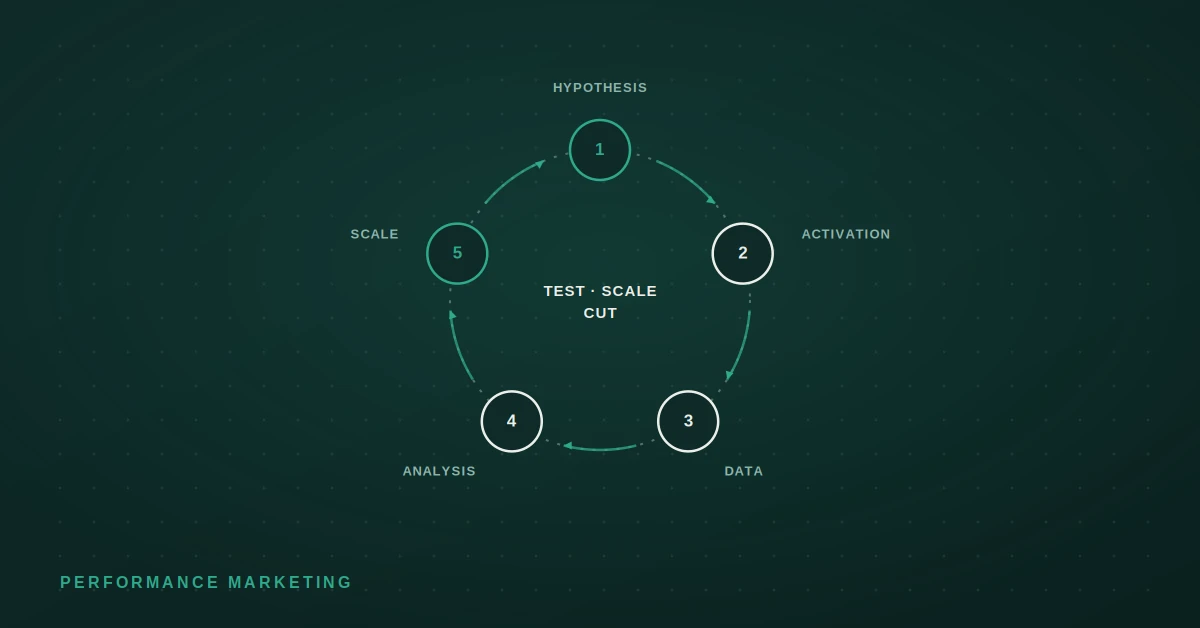
Paid media at Klevie runs as a continuous loop, not a set-and-forget campaign. Analyze the results, scale what works, and cut what does not. New ideas enter as tests; the winners get more budget and more variations; the losers are removed before they drain the account. Nothing scales on a hunch, and nothing keeps spending because it once looked promising.
This matters because most wasted ad budget comes from two habits: scaling something before it has proven itself, and leaving underperformers running out of inertia. A disciplined loop removes both. It also means the account gets sharper over time rather than heavier, because spend concentrates on what the evidence supports. Deciding where paid media should even point comes first, from the strategy and the diagnosis; performance fills the funnel that strategy defines. How the channels, targets and budgets are set is covered in paid media strategy for scaling brands.
The testing framework behind it
Behind the loop sits a structured testing framework, run as fast cycles of experimentation. Each cycle moves through five stages:
- Hypothesis development. Define what you are testing and why, structure the creative approach, and shape the media concepts. A test starts with a clear question, not a vague “let’s try this”.
- Activation. Launch the approved concepts across the funnel and cross-channel.
- Data collection. Monitor continuously until the results are statistically meaningful, rather than reacting to the first day’s noise.
- Analysis and insights. Validate the results, identify patterns, and turn them into actionable recommendations.
- Iteration and scale. Adjust, reuse and scale the concepts that performed best.
The point of a framework is that learning compounds. Every test either produces a winner to scale or an insight that sharpens the next test. Over time the account is spending better and, more importantly, understanding the customer better, which is the durable advantage.
The discipline lives in the details. A good hypothesis names one variable, a predicted effect, and the metric that will settle it, so the test answers a real question instead of producing an ambiguous chart. During a test, judgment is held until the data is statistically meaningful, because acting on the first day’s numbers is how teams scale noise and kill winners early. Where a full conversion signal is slow or thin, a proxy metric further up the funnel keeps the loop moving without waiting weeks for certainty. And results are read before, during and after the test, so the comparison is honest rather than a story told after the fact.
In practice, the work runs as a sequence: turn the data you already have into insights and testable opportunities, define the critical elements to test (audience, channels, message, format), develop the hypotheses and experiments with proxy metrics attached, monitor results across the full test window, and iterate on the learnings while scaling what generates impact. The framework is what keeps a busy account from drifting into activity that feels productive and proves nothing.
What gets tested
The main levers are landing pages, audiences, creatives and copy. Most teams test creative and copy and stop there. The bigger wins usually come from testing audiences and landing pages, because those decide who sees the message and where they land, which often matters more than the wording itself. A weak creative in front of the right audience on a strong landing page will out-earn a brilliant creative pointed at the wrong people. The framework tests all four, but it sequences them so you learn which lever is actually moving the result rather than changing everything at once and guessing.
Creative, and why it decays
Creative is the lever with the shortest half-life. An ad that works will stop working, because the audience seeing it has now seen it several times and the platform has to reach further into a colder pool to keep spending. Cost per result drifts up, and the account looks like it has hit a ceiling when it has actually hit fatigue. The answer is a production rhythm rather than a single hero asset: enough new concepts entering the account to replace what burns out, and enough variation within a winning concept to extend its life before it goes.
The useful distinction is between a concept and a variation. A concept is an idea about why someone should buy, and it is what actually wins or loses. A variation changes the execution of that idea: the hook, the format, the first three seconds, the frame that carries the offer. Testing twenty variations of a concept the market does not care about produces twenty ways to lose, which is why the framework starts from a hypothesis about the buyer rather than from a list of things to try. Creative also has to match the funnel stage it sits in. What convinces someone who has never heard of the brand looks nothing like what nudges someone who left a full cart yesterday.
Audiences: the lever most teams underuse
Who you show an ad to matters as much as what the ad says. Audiences are a primary test lever, not a set-up step you configure once and forget. The work spans prospecting audiences that find new customers and retargeting audiences that convert people who already engaged, and it leans heavily on first-party data, which has become the most valuable audience signal a brand owns.
The strongest gains often come from matching the right creative to the right audience, rather than pushing one message at everyone. A test that looks like a creative test is frequently an audience test in disguise: the same ad performs completely differently in front of a cold prospecting audience versus a warm retargeting one. Treating audiences as something to test, segment and refine is what separates accounts that plateau from accounts that keep finding profitable room to grow.
In practice the audience work spans a few layers. Cold prospecting reaches people who have never heard of the brand, whether through broad targeting that lets the platform find buyers, interest and behaviour segments, or lookalikes built from your best existing customers. Warm retargeting works the people who visited, added to cart or engaged, and usually converts at a far lower cost because the intent is already there. Underneath both sits first-party data: your customer list, site events and purchase history, which is now the most durable audience signal a brand owns as third-party cookies disappear. Exclusions matter as much as inclusions, because paying to retarget people who already bought, or to prospect an audience that never converts, is a quiet drain that a disciplined account removes.
Scaling audiences is its own skill. Push a winning audience too hard and frequency climbs, fatigue sets in and cost per result drifts up; expand too cautiously and growth stalls. The loop handles this by widening in steps, watching the cost per customer as it goes, and refreshing creative before an audience burns out. All of this depends directly on the tracking and data underneath, which is where most brands quietly lose the signal.
Tracking and measurement, including server-side
Performance marketing is only as good as the data it runs on. If the tracking is wrong, every decision downstream is wrong: you scale the wrong campaigns, cut the wrong ones, and optimize against numbers that do not reflect reality. Getting measurement right is not a technical footnote, it is the foundation the whole system stands on.
The complication is that browser-based tracking has degraded. Privacy changes, cookie loss and operating-system restrictions mean a growing share of conversions never make it back to the ad platforms through the browser alone. When a shopper opts out of tracking, blocks a pixel, or converts days later on a different device, the browser pixel simply misses it, and the platform reports fewer conversions than actually happened. Optimizing against that gap means starving your best campaigns of budget because they look worse than they are.
Server-side tracking restores much of that signal by sending conversion data from your own server to the ad platforms directly, rather than relying only on the browser. The payoff is twofold: more accurate reporting, so you optimize against real results, and better signal fed back to the ad platforms, so their algorithms find customers more efficiently. That second point is easy to underrate. Modern ad platforms are only as smart as the conversion data you feed them, so a clean server-side feed improves your reporting and, at the same time, the platform’s ability to target on your behalf. As privacy rules tighten, this moves from nice-to-have to the difference between an account that can measure itself and one that cannot. Setting it up well, and keeping it accurate, sits at the border of performance and data, and it is worth treating as its own project rather than an afterthought.
Attribution: why the platforms disagree with your bank account
Even with clean tracking, the numbers in the ad platforms will overstate reality, and understanding why keeps you from making expensive decisions on flattering data. Every platform reports on its own conversions, and each one claims a sale it touched. Add up what the platforms say they delivered and the total will comfortably exceed the orders in the shop, because the same customer, who saw a social ad, searched the brand, then bought, gets counted more than once. Nobody is lying. Each is answering the question “did I contribute” rather than “was I the reason”.
The correction is to keep two views. Platform figures are useful for steering within a channel: which campaign, which audience, which creative is pulling. Blended numbers are what tell you whether the business is winning: total marketing spend divided by total new customers, checked against the margin each customer brings. When those two views drift apart, the blended number is the one that matches the bank account.
Beyond that sits the harder question of incrementality: whether a customer arrived because of an ad, or would have arrived anyway. Retargeting flatters itself here, because it takes credit for people already on their way to buying. The way to test it is to withhold: hold out a region or an audience, run the channel everywhere else, and compare. It costs a little revenue in the short term and it settles arguments that spreadsheets cannot. For most brands the practical version is simpler: watch what the blended cost per new customer does when a channel scales up or turns off. If nothing moves, that channel was taking credit rather than creating demand.
The metrics that matter
If ROAS is a weak scoreboard, the question is what to watch instead. A short set of numbers tells you whether acquisition is genuinely healthy. Customer acquisition cost (CAC) is the real, blended cost of winning a customer, counted across everything spent, not the flattering per-platform figure each channel reports for itself. Contribution margin after acquisition is what a customer leaves behind once product, fulfillment and acquisition costs are paid, and it is the number that decides whether scaling spend builds profit or losses.
Two more matter as you grow. Payback period is how long it takes a customer to repay what you spent to acquire them, which governs how fast you can safely reinvest and how much cash the growth ties up. Lifetime value against CAC tells you whether the whole model works: a customer who costs more to acquire than they ever return is a loss dressed up as growth, and no amount of clever creative fixes it. Watching these together, rather than ROAS alone, is what keeps performance honest. It also connects paid media to retention, because the cheapest way to improve the value side of that ratio is often to keep the customers you already paid to acquire, which we cover in customer retention strategy for ecommerce. Each of these numbers, and how to calculate it honestly, is worked through in how to measure marketing ROI.
Conversion rate optimization
Paid media brings people to the door; conversion rate optimization (CRO) decides how many walk through it. Every point of conversion you gain lowers the effective cost of every customer, which is why CRO is one of the highest-leverage parts of performance. The levers are concrete: the clarity of the landing page and how well it matches the ad that brought the visitor, the strength and framing of the offer, page speed, the trust signals a first-time buyer looks for, and the amount of friction between the add-to-cart and the confirmed order. For DTC and ecommerce brands especially, a small lift in conversion can do more for profit than a large increase in traffic, because you are getting more from budget you already spent. CRO and paid media compound: better conversion lets you bid more aggressively for the same target cost, which opens up audiences that were previously too expensive to reach. We go through the leaks and what to test first in conversion rate optimization for DTC ecommerce.
Where organic fits
Paid acquisition and organic search are usually run by different people with different vocabularies, and they answer the same question: how does a customer arrive, and what did it cost. Treating organic as an acquisition channel, measured against cost per customer like any other, is what makes it comparable to paid rather than a separate act of faith. Traffic that arrives without a click cost lowers the blended number that decides whether growth is profitable, which is why the two belong in the same conversation.
They also feed each other. Search data from paid campaigns shows the language buyers actually use, which sharpens the content worth building. A landing page tested and proven against paid traffic is a better page for organic traffic too. And as AI assistants become a route through which people find and shortlist brands, the same discipline applies to being cited by them: structured, clear, quotable content earns a place in the answer, and the return is measured the same way, against customers acquired and what they cost.
How execution actually runs
Good performance is as much about process as ideas. At Klevie the flow is deliberate: an approved strategy leads to an approved media plan, then into creative production with internal Klevie QA, a preview for the brand, and a final QA before anything goes live. From there it moves to campaign setup and activation. This sequence reduces errors, speeds up implementation, and keeps strategy and activation consistent, so what launches is what was actually planned. Running underneath it is strategic account management, so the work stays tied to the outcome rather than drifting into busywork.
The principle across all of it: scale only what proves it generates results. That discipline is what turns spend into efficiency, clarity and sustained growth, rather than a rising bill with a flat return.
Where performance marketing goes wrong
The failures repeat across accounts. Optimizing to ROAS without knowing the margin behind it, so a number that looks like a win is a break-even in disguise. Scaling a campaign after two good days, before the data means anything. Leaving underperformers alive out of sunk-cost sentiment. Testing creative endlessly while the audience and the landing page, the two levers with more leverage, stay untouched. Trusting platform-reported conversions as if they were the business’s numbers. Running acquisition hard while retention leaks out the back, which turns growth into a treadmill that costs more each month.
Underneath most of them is the same habit: measuring the activity rather than the outcome. An account can be busy, well-managed and full of tests, and still be pointed at the wrong result. That is why performance work is worth tying to a number the business actually feels, and why the question of whether acquisition is even the constraint comes before any of it.
How this ties back to profit
Everything above points at one outcome: customers acquired at a cost that leaves margin, and a system that gets more efficient as it scales. That is why Klevie ties its own incentives to results, through a model that pairs a base fee covering operational cost with a performance fee tied to the KPIs agreed with the client. The point is shared risk: performance marketing should grow the profit the business keeps, and the commercial model is built to reflect that. Where the real constraint on growth sits outside acquisition, the starting point is a diagnosis through the Klevie Growth Engine, so spend goes to the thing that actually moves the business.
Frequently asked questions
What is performance marketing?
Paid acquisition run against measurable results, across channels like search and social, plus the conversion work after the click. Spend follows evidence, and every campaign has a result attached.
What is the difference between performance marketing and paid media?
Paid media is the buying: campaigns on search, social and other platforms, judged inside the ad account. Performance marketing is the wider discipline of acquiring customers against a business result, including the buying, the conversion experience, the measurement underneath and the margin that decides whether it was worth doing.
What is a good ROAS?
It depends entirely on your margin. Breakeven ROAS is one divided by the share of an order that survives product cost, shipping, fees and returns. At a 50% margin you break even at 2x; at 35% you break even close to 3x. A ROAS figure means nothing until you know the margin behind it.
Why is ROAS not enough to judge a campaign?
ROAS compares revenue to ad cost alone and ignores product cost, fulfillment, fees and returns. A campaign can show a healthy ROAS and still lose money. Contribution margin after acquisition is the number that tells you whether growth is profitable.
Why does server-side tracking matter?
Browser tracking has degraded through privacy changes and cookie loss, so many conversions never reach the ad platforms. Server-side tracking restores that signal, giving more accurate reporting and feeding better data back to the platforms so they acquire customers more efficiently.
Why are audiences so important in paid media?
Who sees an ad matters as much as what it says. The same creative performs very differently across cold prospecting and warm retargeting audiences, and first-party data is now the most valuable audience signal a brand owns. Audiences are a primary thing to test, not a one-time setup.
How does performance marketing grow the profit a business keeps?
By optimizing against contribution margin after acquisition, testing to find what works, scaling only proven winners, and cutting waste. Revenue and ROAS can rise while profit falls; optimizing for margin keeps acquisition profitable as it scales.
Want paid media measured on the profit it grows?
That is how we run performance. Request a strategy call and we will look at where your acquisition is leaking margin and what to test first.