
Almost all AI advice is written for companies with thousands of employees and budgets to match. For a small or mid-sized business, the useful version is narrower and clearer. AI pays off when it takes a repetitive, rule-bound task off a person who is worth more elsewhere, and it wastes money almost everywhere else. The skill is telling the two apart before you spend. This is a practical map of where AI earns its keep in an SME, and where it does not.
Why the enterprise advice does not fit
Read the AI coverage aimed at large companies and it is about reinventing the core, reorganizing thousands of people, and running portfolios of dozens of pilots. That advice fits a bank with twenty billion in technology spend. For a business with thirty people it is useless, because it assumes resources and problems an SME does not have.
The reality of an SME is the opposite of a sprawling transformation. You have a small number of people wearing several hats each, and the constraint is time, not org structure. Someone spends a day a week on a task that is beneath them. A founder does admin at night that a system could handle. That is where AI belongs in a smaller business: handing back the hours a few people are losing to work that does not need them.
Where AI pays off in an SME
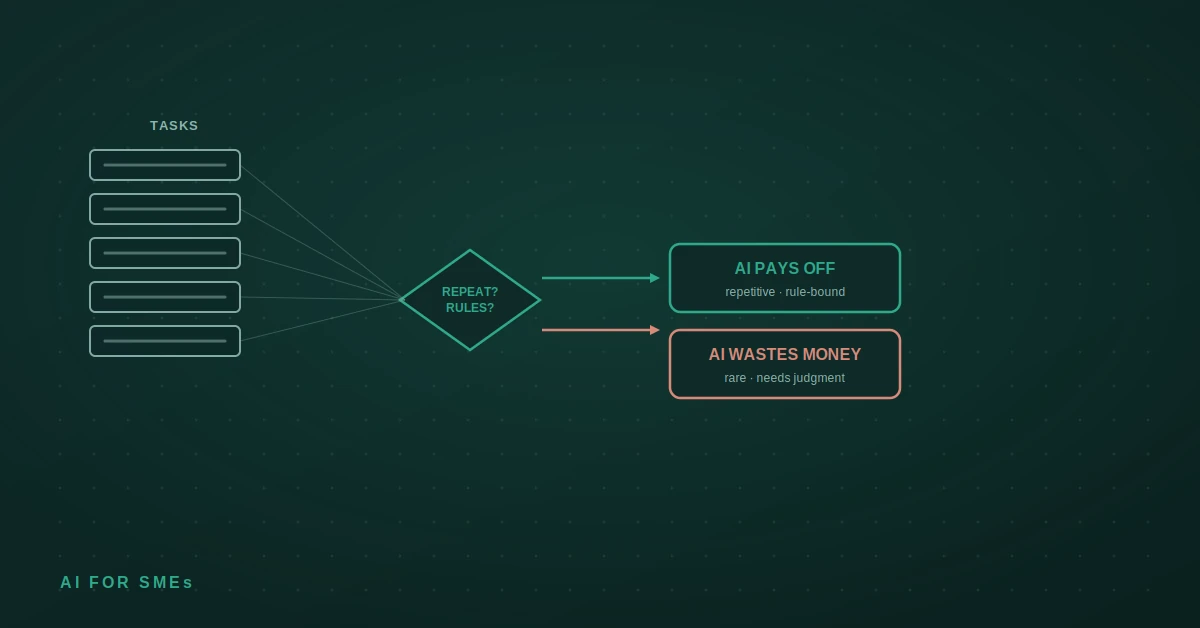
The candidates that reliably return more than they cost share the same shape: repetitive, high volume, rule-bound, and currently done by a person whose time is worth more on something else. A few concrete places this shows up.
Pulling data out of documents
Invoices, contracts, forms, orders arriving as email attachments, PDFs and scans, retyped by hand into another system. This is among the clearest wins in a smaller business, because the volume is high, the rules are firm, and the cost of the quiet errors, a duplicated invoice paid twice, a contract that auto-renews unnoticed, is real. A system that reads the document and checks the result against firm rules removes the retyping and catches the mistakes.
Reading and sorting what comes in
Requests, enquiries and applications that arrive as free text and have to be read, understood and routed by a person. A system can do the first pass, structure the request, and either draft a response or send it to the right place, while a person keeps the decisions. The time saved is the reading and sorting that fills an inbox.
Monitoring something across many sources
Competitor prices, stock levels, listings, anything a person currently checks by hand across many places and that is stale the moment they finish. A system does it continuously, which turns a periodic manual chore into current information the business can act on.
Producing the same output on a schedule
The report assembled from the same sources every week, the listings written to the same template at scale. Repetitive production work with a fixed shape is well suited to a system, with a person reviewing rather than building from scratch each time.
Where AI does not pay off
Just as important, and rarely said by anyone selling AI. A task is a poor candidate when it is rare, when it needs genuine human judgment every time, or when a mistake is costly and hard to catch. Automating something that happens twice a month burns more in build cost than it will ever return. Handing a real decision to a model, one that has to be right and consistent, invites exactly the inconsistency a model produces. And a process where an error is expensive and invisible is one to keep close to human hands until the checks around it are strong.
The other place AI does not pay off is when it is used to avoid fixing the actual problem. If the real issue is a broken process, unclear pricing, or a product that disappoints, a layer of AI on top just makes the broken thing faster. The question is always what is actually costing the business, and whether AI is the right tool for that specific thing, or a distraction from it.
How to tell the difference before you spend
The test is a short one, applied honestly to each candidate task. Is it repetitive and high volume, or rare? Is it rule-bound, or does it need judgment every time? Is the person doing it worth more elsewhere? And if it goes wrong, will you catch it? A task that is repetitive, rule-bound, done by someone valuable, with catchable errors is a strong candidate. A task that fails any of those is usually not, however tempting the technology.
Running that test across a business is a diagnosis, and doing it before any build is what separates money spent from money wasted. Map where time is trapped, rank the candidates by effort against the hours and margin they would return, and be willing to conclude that some of them, sometimes the most obvious ones, are not worth automating yet. We run this through the same discipline as the rest of a business, the Growth Engine, so the answer rests on the numbers rather than on enthusiasm.
What this looks like in practice
The systems we have built for smaller businesses follow this exactly, described generally because the clients stay anonymous. A retailer needed prices tracked across roughly fifty thousand references from seven competitors, a task that consumed a person’s week every month and was out of date immediately; a system now does it continuously and gives that week back. A personal trainer was running scheduling, bookings, the sales pipeline, invoicing and insurance around the actual training; a platform now holds all of it and reads the data to inform decisions on classes, timetabling and pricing, which let the business drop a part-time hand and let the trainer go full-time on training. Neither is a transformation. Each one took a specific load off a specific person, which is what AI is for in a business this size.
The pattern underneath is worth keeping. For an SME, AI is not a strategy, it is a tool for removing specific, repetitive work. Used that way it pays for itself quickly. Used as a banner to “do something with AI”, it becomes another expensive pilot that never earns back its cost. The difference is entirely in choosing the right task first. The mechanics of how these systems are actually built are covered in AI systems that do your business’s repetitive work.
Frequently asked questions
Is AI worth it for a small business?
Yes, when it takes a repetitive, rule-bound task off a person whose time is worth more elsewhere. It is not worth it for rare tasks, tasks needing judgment every time, or where a mistake is costly and hard to catch. The value is in choosing the right task.
What are the best AI use cases for an SME?
Pulling data out of documents, reading and sorting incoming requests, monitoring prices or stock across many sources, and producing repetitive output on a schedule. All are high volume, rule-bound, and currently eating a person’s time.
Where does AI not pay off?
On rare tasks, tasks needing genuine judgment each time, and processes where an error is expensive and invisible. Also when AI is layered on top of a broken process, unclear pricing or a weak product, which just makes the underlying problem faster.
How do I decide where to use AI in my business?
Test each task: is it repetitive and high volume, rule-bound, done by someone whose time is worth more elsewhere, and will you catch an error? A task that passes all four is a strong candidate. Do this diagnosis before committing to any build.
See it working
30 hours a month of invoice chasing, down to under 2, in a back office that stopped chasing paper.
Or see how we build AI systems, end to end.
Wondering where AI fits in your business?
For a smaller business the answer is usually one or two specific tasks, not a transformation. Request a strategy call and we will map where it would pay off, and where it would not.