

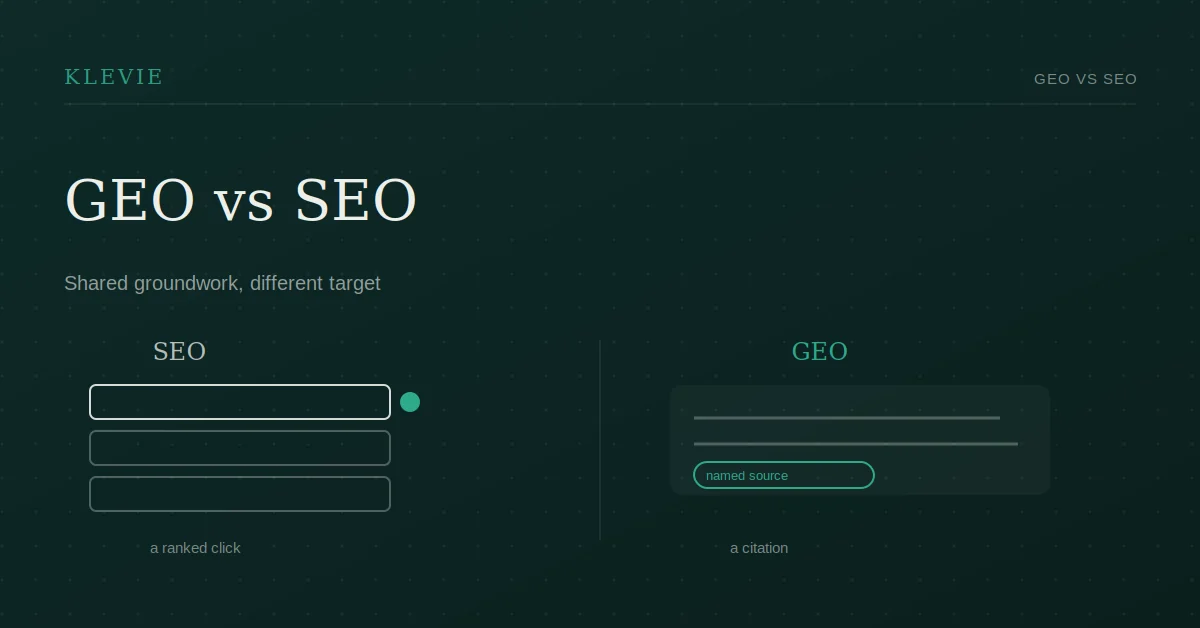
GEO and SEO overlap far more than the hype admits. Both depend on machines reading the web and deciding your content is worth surfacing, so most of the groundwork is shared. What changes is the target: SEO competes for a ranked position and a click, GEO competes to be a named source inside an answer. The honest conclusion is that GEO is an extension of good SEO, not a replacement for it. Here is what actually shifts, and what does not.
The one real difference: the target
Strip away the noise and there is a single fundamental difference. SEO aims at a position on a results page, high enough to earn the click that brings a visitor to your site. GEO aims at being one of the few sources an answer engine draws on and names when it composes an answer, which may bring no click at all, because the value is being the authority the answer is built from. Everything else that differs between them follows from this one shift in what you are competing for.
What changes
The click is no longer guaranteed
In search, the whole point was the click. In an AI answer, your content can shape the answer and be cited without the user ever visiting your site. That reframes what a win looks like: presence in the answer, and being named as the source, becomes valuable in itself, even when traffic does not follow. It also means some informational queries that used to bring visitors now get answered in place, which changes what that content is for.
Structure and self-contained answers matter more
Search rewarded structure too, but an answer engine leans harder on content it can lift cleanly. Statements that stand on their own, headings phrased as the questions people ask, and an answer placed early all matter more when a machine is composing rather than a person scanning. The clearer and more self-contained the useful part, the easier it is to cite.
Being the original source gains value
In search, several pages saying similar things could all rank. In a generated answer, the engine reaches for the source that holds the specific it needs, so original data, your own results, a named method, become disproportionately valuable. Being the source of a fact is worth more when a machine is choosing exactly one or two to cite.
What stays the same
Machines still read the web
The technical foundation is shared. A site that is fast, crawlable, well structured and marked up with clean data is easier for both a search engine and an answer engine to read. The work of making your content legible to machines carries straight across, and matters more.
Expertise and trust still decide
Search already rewarded content from credible, identifiable experts, and answer engines lean on the same signal, because an engine trying not to be wrong is helped by knowing a credible person stands behind a claim. Real authorship, real credentials and a real reputation carry across both.
Genuinely useful content still wins
The content that ranked well in search, accurate, specific, clearly written, answering a real question, is the content answer engines cite. Both systems are ultimately trying to serve a person a good answer, so both reward the same underlying quality. Thin content built to game a ranking loses in both.
So should you replace SEO with GEO?
No, and framing it as a replacement is the mistake. Because the foundations are shared, the work you do to be citable by answer engines mostly strengthens your search presence too, and the reverse. The right move is to keep doing good SEO and extend it with the things GEO leans on harder: answer-first structure, self-contained statements, original specifics, and visible expertise. You are not choosing between two disciplines, you are doing one well enough to serve both ways of being found. The concept behind the GEO half is set out in what generative engine optimization is, and the practical tactics in how to get cited by AI answer engines.
Where both sit in the wider shift in AI and marketing is covered in AI for growth marketing.
Frequently asked questions
What is the difference between GEO and SEO?
SEO competes for a ranked position and the click that follows. GEO competes to be a named source inside an AI-generated answer, which may bring no click. They share most of the groundwork, because both depend on machines reading the web, but the target differs.
Does GEO replace SEO?
No. The foundations are shared, so the work to be citable by answer engines mostly strengthens search presence too. The right approach is good SEO extended with what GEO leans on harder, rather than one instead of the other.
What changes most when moving from SEO to GEO?
The click is no longer guaranteed, structure and self-contained answers matter more, and being the original source of a specific gains value, because an engine cites the source that holds the fact it needs.
What stays the same between SEO and GEO?
Machines still read the web, so technical health matters; expertise and trust still decide, so real authorship counts; and genuinely useful, specific content still wins, because both systems try to serve a person a good answer.
Wondering how to split effort between SEO and GEO?
For most businesses it is one program, not two. Request a strategy call and we will look at where your effort would do the most across both.
How we work on this: marketing and performance.