

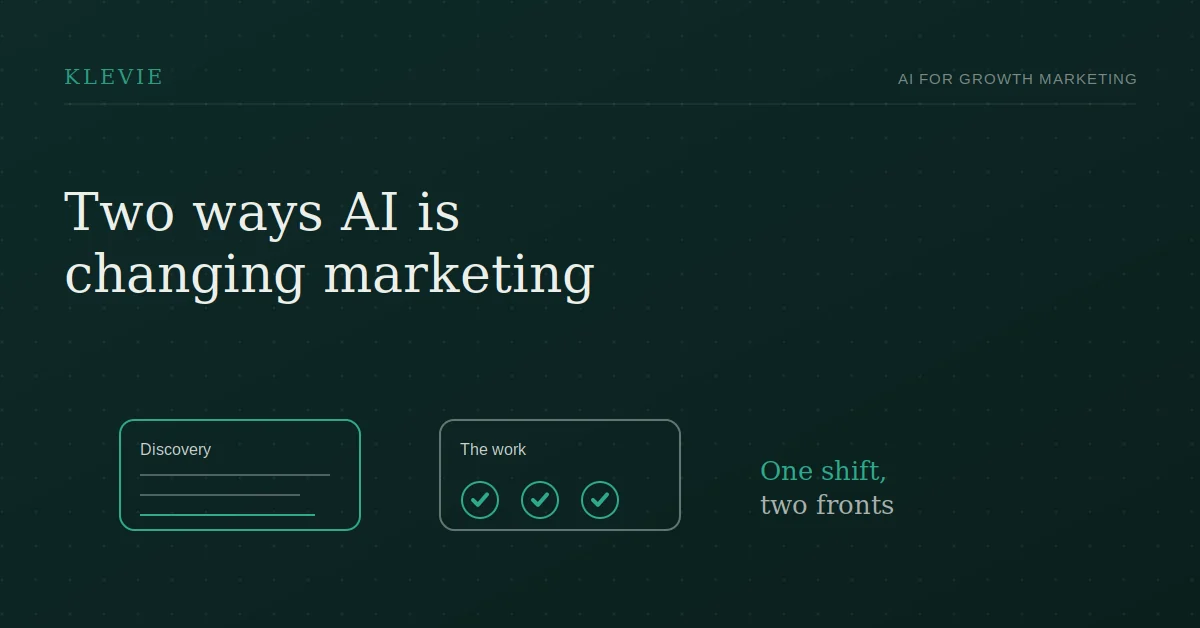
AI changes growth marketing in two distinct ways, and confusing them wastes money. The first is a shift in how people find things: they increasingly ask an AI answer engine instead of scrolling a page of search results, which changes what it takes to be discovered. The second is a set of tools that make the marketing work itself faster. This guide keeps them separate, because being cited by an AI engine and using AI to write faster are different problems with different answers.
Two things people mean by “AI marketing”
When someone says they want to “use AI in marketing”, they usually mean one of two things without realizing they are different. One is about being found in a world where people ask AI engines questions. The other is about pointing AI tools at the marketing tasks a team already does, to do them faster or at more scale. Both matter. They need different work, different skills, and different ways of measuring success, so the first useful move is to say which one you are talking about.
The rest of this guide takes them in turn: first how discovery is changing and what generative engine optimization actually is, then where AI genuinely helps the marketing work, and finally how to tell the real gains from the noise.
How discovery is changing
For twenty years, being found meant ranking on a search engine: appear high on the page, earn the click, bring the visitor to your site. That still happens, and it is now sharing space with a different behavior. People ask an AI answer engine a question and get a written answer that names a few sources, rather than a list of ten links to choose from. The answer engines doing this are several, and they are not one company: large language model assistants like Claude and ChatGPT, AI-native search like Perplexity, Google’s Gemini and its AI Overviews sitting on top of ordinary results. The common thread is that a machine reads the web and composes an answer, deciding which sources to trust and name.
This matters for growth because the unit of discovery shifts. In classic search, you competed for a ranking and a click. In an AI answer, you compete to be one of the handful of sources the engine draws on and cites. You may never get the click at all; the value is being the brand the answer is built from, named as the authority on the question your customer just asked. That is a different game, and optimizing for it has a name.
What generative engine optimization is
Generative engine optimization, or GEO, is the work of making your content the kind of thing an AI answer engine draws on and cites when it answers questions in your area. Where search engine optimization aimed at ranking a page, GEO aims at being selected as a trusted source inside a generated answer. The two overlap, because the engines still read the web to build their answers, but the target is different: in place of a position on a results page, a place inside the answer itself.
Nobody, including the companies that build these engines, can hand you a formula that guarantees a citation. What is visible is the pattern in what gets cited, and it is less mysterious than the hype suggests. Content that answers a specific question directly and early, states things plainly, backs claims with concrete specifics, and is written by an identifiable expert tends to be the kind of thing an engine can safely lean on. The deeper mechanics are covered in what generative engine optimization is, the practical tactics in how to get cited by AI answer engines, and how it relates to classic search in GEO vs SEO.
Why GEO rewards the same things good writing always did
The reassuring part is that GEO does not reward tricks. An answer engine is trying to give its user a correct, useful answer, and it citing you means it decided you were a safe source for one. So the incentives point at exactly what a thoughtful reader wanted anyway: answer the question, be specific, be accurate, be clearly written by someone who knows the subject. Content built to manipulate a ranking tends to be the content an answer engine avoids, because it is trying not to be wrong. The practical implication is that GEO and writing genuinely useful content are mostly the same activity.
Where AI helps the marketing work itself
The second meaning of AI in marketing is more grounded and less discussed: using AI tools to do the work faster. This is real, and it is also where a lot of money gets wasted on tools that produce volume nobody needed.
The honest version treats AI the way any operational AI system should be treated, as something that removes repetitive work from a person whose time is worth more elsewhere. In marketing that looks like drafting variations of ad copy for a human to select and refine, producing first drafts of many product descriptions to a fixed template, summarizing research or reviews into themes, monitoring competitors across many sources. In each case the model does the repetitive first pass and a person keeps the judgment, which is the same principle behind every well-built AI system. We go through the practical uses in AI for marketing workflows, the tools worth the money in AI tools for growth marketing, and how to use AI on content without producing filler in AI for content and SEO without the slop.
One concrete example from work we have done, kept anonymous: a retailer needed to track prices across roughly fifty thousand references from seven competitors, a task that took a person a week every month and was stale the moment it was done. Moving that to a system freed the week and turned a monthly snapshot into current information the team could price against. That is what AI in marketing should look like, hours removed and a decision made better, rather than more content for its own sake.
Where AI does not help
Worth saying plainly, because the pressure to “use AI” pushes teams into it. AI does not fix a weak offer, and it does not make undifferentiated content valuable by producing more of it. Flooding a blog with AI-written articles that say nothing works against GEO, because answer engines are selecting for trustworthy specifics and will pass over generic volume. And AI does not remove the need for a strategy: pointing it at the wrong task produces the wrong output faster. The decision of what is worth doing comes first, from the strategy and the diagnosis, and AI helps execute it, rather than replacing it.
How to tell the real gains from the noise
Both halves of AI in marketing attract inflated claims, so a few honest tests help. For discovery, the question is whether your content is actually being cited in AI answers to the questions your customers ask, which you can check by asking those questions in the engines and seeing who gets named. For the tools, the question is whether they remove hours a person was spending or genuinely improve a decision, measured against a baseline, rather than whether they produce impressive-looking volume. Anything that cannot answer one of those two questions is probably noise.
Underneath both is the same discipline the rest of growth runs on: decide what actually matters, do that, and measure it honestly. AI is a powerful way to execute and a poor substitute for knowing what to execute. Where it fits in the wider picture, alongside paid, conversion and retention, is set out in the performance marketing guide.
Frequently asked questions
What is AI for growth marketing?
Two different things: being discovered when people ask AI answer engines questions, which is generative engine optimization, and using AI tools to do marketing work faster. They are separate problems with separate answers, and confusing them wastes money.
What is generative engine optimization (GEO)?
The work of making your content the kind of thing an AI answer engine trusts and cites when it answers questions in your area. Where SEO aimed at ranking a page, GEO aims at being named as a source inside a generated answer.
How is GEO different from SEO?
SEO competes for a position on a results page and a click. GEO competes to be one of the few sources an AI engine draws on and cites, which may not produce a click at all. They overlap because engines still read the web, but the target differs.
Does using AI to write more content help with GEO?
No. Answer engines select for trustworthy, specific content and pass over generic volume, so flooding a site with AI-written filler works against you. GEO rewards the same things good writing always did: answer the question, be specific, be accurate.
Where does AI genuinely help marketing work?
By removing repetitive first-pass work from people, drafting copy variations, producing template-based descriptions, summarizing research, monitoring competitors, with a person keeping the judgment. The test is whether it removes hours or improves a decision, not whether it produces volume.
Not sure what AI actually changes for your marketing?
The answer is usually narrower and more useful than the hype. Request a strategy call and we will look at where AI would help your growth, and where it would not.
How we work on this: marketing and performance.