
The risk in buying AI is that it turns into an open-ended development project, measured in scope and sprints and billed by the hour. The way to avoid that is to buy the outcome instead: start with a paid diagnosis that finds where the work is worth removing, build one or two systems in a fixed sprint, then keep them running, priced to the value rather than the build hours. You are buying hours removed and margin recovered, not lines of code. This is how to structure it so it stays focused.
Why AI projects drift into expensive dev work
Left unstructured, an AI initiative slides into the shape of a software project. Scope expands, timelines stretch, and the bill arrives by the hour, the same model as a development shop. That serves the vendor and rarely the buyer, because it rewards effort rather than result, and it puts the risk of things taking longer entirely on you.
The deeper problem is that it starts from the wrong question. A software project asks “what should we build”. The right starting question is “where is repetitive work costing us time and money, and is removing it worth more than it costs”. Answer that first and the build becomes small, specific and bounded. Skip it and you are paying to build something nobody confirmed was worth building.
The three-step path
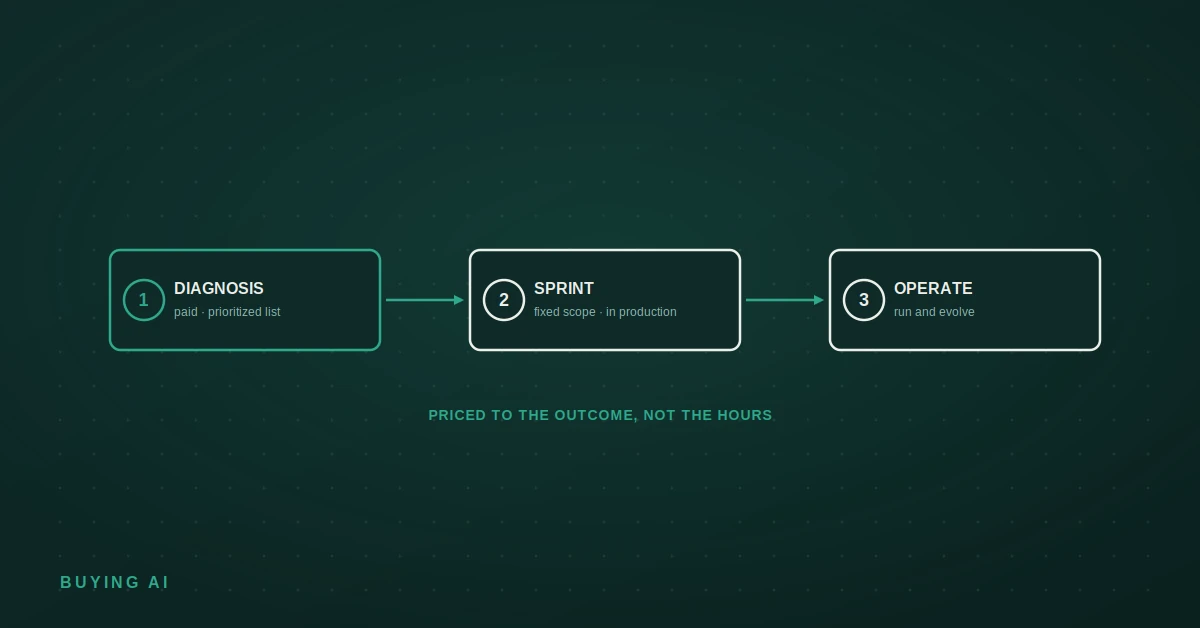
Step 1: a paid diagnosis
Before any build, a short, paid engagement maps where the repetitive work lives and what removing it is worth. It ends in a prioritized list of opportunities, ranked by the effort to automate them against the hours and margin they would return. Sometimes the most valuable line on that list is the one that says a given task is not worth automating yet. The diagnosis being paid matters: it means the work is judged on its own value, not given away to win a bigger build.
Step 2: an implementation sprint
Then a focused sprint, a matter of weeks rather than an open-ended program, with a fixed scope and a real deliverable: one or two systems in production. The point of the fixed scope is to keep the project from becoming the thing it should avoid. You are not commissioning a platform, you are putting a specific system to work on a specific task.
Step 3: operation and evolution
Once live, the system is kept running and improved as the business changes. Rules get adjusted, new documents or request types get added, thresholds move as agreements move. This is ongoing, because a system that is never maintained drifts out of date, but it is maintenance of a working asset, not an endless build.
Price the value, not the hours
The pricing follows the outcome. Rather than a bill for build hours, the model is a fee that covers the operating cost plus a performance fee tied to the result. This aligns the work with what you actually want, hours removed and margin recovered, and it puts some of the provider’s compensation on the same side as your result. A vendor billing by the hour earns more when the project takes longer. A vendor paid on the outcome earns more when the system works and keeps working.
This is the same commercial logic we apply across the business: a base fee that covers operating cost plus a performance fee tied to the KPIs agreed with the client. It is worth being clear about what “value” means here, hours of work removed, errors avoided, margin recovered, measured against a baseline you agree at the start, rather than a vague promise of transformation.
Settle these before any code
The questions that decide whether a system can actually go live are usually not technical, and they belong at the start, not the end. Three in particular. Where is the data hosted, and under what data-processing terms. Who is allowed to see and approve what. And how long originals are kept, and what happens when that period ends. For confidential or regulated work this means hosting in the right jurisdiction, a proper data-processing agreement, a model provider on zero retention, and access logging. A system that handles client documents or client data cannot go live without these settled, so settling them first saves building something that then cannot be used.
Questions to ask a provider
A short list separates a genuine outcome-focused partner from a dev shop selling AI. Does the engagement start with a diagnosis, or straight with a build? Is the scope of the first build fixed, or open-ended? Is the pricing tied to the result, or to hours? Where do the decisions live, in explicit rules you can edit, or inside the model? What is the metric of success, and is it the share of work done without intervention rather than a demo that impressed once? And are the data, hosting and retention questions being raised now, or left for later? The answers tell you quickly whether you are buying an outcome or signing up for a project.
The thing being bought, in the end, is a specific task taken off specific people, reliably. How these systems are actually built, and the principle that keeps them trustworthy, is covered in AI systems that do your business’s repetitive work.
Frequently asked questions
How much does an AI system cost to build?
The useful answer is not a build price but a value comparison: what the repetitive work costs today against what removing it is worth. Priced to the outcome, a fee covering operating cost plus a performance fee tied to the result, rather than an open-ended bill for build hours.
How do I stop an AI project becoming an endless development job?
Start with a paid diagnosis, then a fixed-scope sprint delivering one or two systems in production, then maintenance of a working asset. The fixed scope and the outcome-based pricing are what keep it from drifting into open-ended dev work.
What should be agreed before development starts?
Where the data is hosted and under what terms, who can see and approve what, and how long originals are kept. For confidential work that means the right jurisdiction, a data-processing agreement, a zero-retention model provider and access logging, settled before code.
How do I know a provider is selling outcomes and not hours?
Ask whether it starts with a diagnosis, whether the first build is fixed-scope, whether pricing is tied to the result, where the decisions live, and what the success metric is. Outcome-focused answers look very different from a project billed by the hour.
See it working
A day a week of studio admin became a day a month, on a platform built without a software project.
Or see how we build AI systems, end to end.
Want AI without an open-ended project?
It starts with a diagnosis, not a build. Request a strategy call and we will find where a focused system would pay for itself.