
The useful question stops being which AI marketing tool is best, because the list changes every quarter and the winner depends on your work. The question that matters is which category of tool removes hours you are actually spending or improves a decision you actually make, and whether a given tool does that well enough to earn its cost. This guide covers the categories that matter and how to judge one, so you can choose as the market keeps shifting.
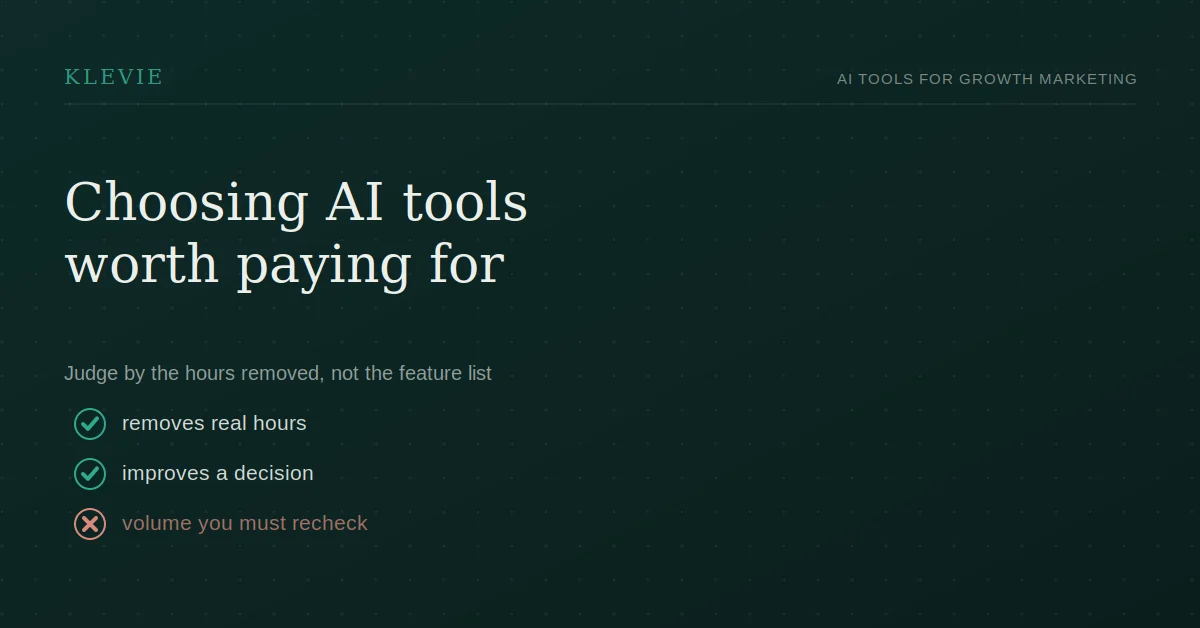
Judge a tool by the hours it removes, not the features it lists
Before any category, the test. An AI tool earns its place when it removes hours a person is spending or genuinely improves a decision, measured against how you work today. Not when it has an impressive feature list, not when it produces a lot of output, not when everyone is talking about it. A tool that generates volume you then have to check and fix has added work, not removed it. Hold every option against that one question and most of the noise falls away.
The categories that matter
Content drafting and variation
Tools that produce first drafts and many variations of copy, ad text, subject lines, product descriptions. What they are for is removing the blank-page effort, with a person selecting and refining. They earn their cost when your team produces enough copy that a faster first draft saves real time, and when there is a review step to keep quality up. They waste money when used to publish unreviewed volume, which works against you.
Research and synthesis
Tools that read large volumes of reviews, feedback, transcripts or documents and surface themes. What they are for is doing the slow reading so a person can interpret faster. They earn their cost when you regularly face more material than a person can read, and the value is in the interpretation the tool leaves to you.
Competitor and market monitoring
Tools that track prices, listings or messaging across many competitors continuously. What they are for is replacing a manual check that is stale the moment it is done. They earn their cost quickly when the monitoring is high-volume and frequent, because the alternative is a person spending days on something that goes out of date immediately.
Analytics and reporting
Tools that assemble recurring reports, surface anomalies, or answer questions about your data in plain language. What they are for is removing repetitive reporting work and speeding up the read of what happened. They earn their cost when the reporting is regular and the tool is accurate enough to trust, and they are a trap when they produce confident answers from data nobody validated.
Creative production
Tools that generate or edit images and video. What they are for is producing more creative variations to test, or handling repetitive production edits. They earn their cost when creative volume is a bottleneck and a person still directs and approves. They waste money when they replace the judgment that makes creative work, or produce generic output that dilutes the brand.
Traps to avoid
A few consistent ways money gets wasted on AI marketing tools. Buying for the feature list rather than a task you actually do, which leaves you paying for capability you never use. Chasing the newest tool every quarter, when the switching cost outweighs the marginal gain. Trusting output nobody reviews, which turns a time-saver into a source of errors you catch later. And buying volume you did not need, on the assumption that more content or more variations is better, when answer engines and customers both reward specifics over volume. The common thread is buying the tool before naming the task.
Start from the task, then pick the tool
The way to choose well is to work backwards from where your time actually goes. Find the repetitive work that eats hours or the decision that suffers from slow or stale information, then look for the category that addresses it, then judge specific tools by whether they remove those hours or improve that decision. This is the same discipline behind any good AI decision: the task comes first, the tool second. Which tasks are worth it in the first place is covered in AI for marketing workflows, and how to use these tools on content without producing filler is in AI for content and SEO without the slop.
Where all of this sits in the wider picture of AI and marketing is in AI for growth marketing.
Frequently asked questions
What are the best AI tools for growth marketing?
The best tool depends on your work and the list changes constantly, so the better question is which category, content drafting, research synthesis, competitor monitoring, analytics, creative production, removes hours you actually spend or improves a decision you actually make.
How do I know if an AI marketing tool is worth paying for?
Judge it by whether it removes hours a person is spending or genuinely improves a decision, measured against how you work today, rather than by its feature list or how much output it produces. A tool that generates volume you then have to check has added work.
What are the common mistakes buying AI marketing tools?
Buying for the feature list instead of a real task, chasing the newest tool every quarter, trusting output nobody reviews, and buying volume you did not need. The common thread is buying the tool before naming the task.
How should I choose an AI marketing tool?
Work backwards from where your time goes: find the repetitive work or the decision that suffers from stale information, identify the category that addresses it, then judge specific tools by whether they remove those hours or improve that decision.
Not sure which AI tools are worth it for your marketing?
The answer starts from your tasks, not the tool list. Request a strategy call and we will map where a tool would pay for itself, and where it would not.
How we work on this: marketing and performance.